AI Digital Worker
AI Digital Worker
An AI-powered order automation service for wholesalers — reading, understanding, and entering orders received via fax, phone, and email directly into your core systems.
What is the AI Digital Worker?
An AI Digital Worker is an AI agent that autonomously performs repetitive operational tasks and works alongside humans as part of the team. It learns and remembers the client-specific rules, tacit knowledge, and industry-specific judgments that veteran employees have built up over years — acting not as a tool, but as a teammate.
With structural labor shortages spreading across industries, hiring alone can no longer bridge the gap. The AI Digital Worker is one answer to the question of how we redesign the relationship between people and systems.
Crucially, the AI Digital Worker is not about replacing people — it is about augmenting them. Harvard Business School and BCG research shows that augmentation outperforms replacement by a wide margin. By offloading repetitive work to AI, people can focus on relationship-building, coaching juniors, and proposing new business.
AITERA's AI Digital Worker is a wholesale-industry order automation service. It reads, interprets, and enters orders received via fax, phone, and email into your core systems — without requiring changes to existing workflows — while preserving veteran tacit knowledge as an organizational asset.
Why AI Digital Workers, and why now
- 11 million
- Workers Japan is projected to be short of by 2040
- 22–25%
- Projected labor shortfall in elderly care, retail, logistics, and construction
- 1 : 1
- Employee-to-AI-agent ratio McKinsey aims for by the end of 2026
- 40%
- Enterprise applications expected to embed task-specific AI agents by the end of 2026
Recruit Works Institute
Recruit Works Institute
McKinsey (roughly 20,000 AI agents alongside ~40,000 employees)
Gartner forecast
Three AI Capabilities
From the moment an order arrives to the moment it lands in your core system, three AIs hand the work off to one another in sequence.
Reading AI
Reads faxes, handwritten notes, scanned PDFs, email bodies, and phone transcripts with high accuracy — no templates required. Handles misaligned tables, distorted handwriting, and varied formats across clients.
Memory AI / SKU Translation AI
Learns and remembers each client's shorthand, industry jargon, their 'usual' orders, and the mapping between manufacturer SKUs and your internal SKUs. Converts veteran tacit knowledge into organizational explicit knowledge.
Verification AI
Assigns a confidence score to each reading result and only auto-enters items above the threshold. Humans review only the uncertain items, enabling safe automation with low error risk.
How the Order Desk Changes
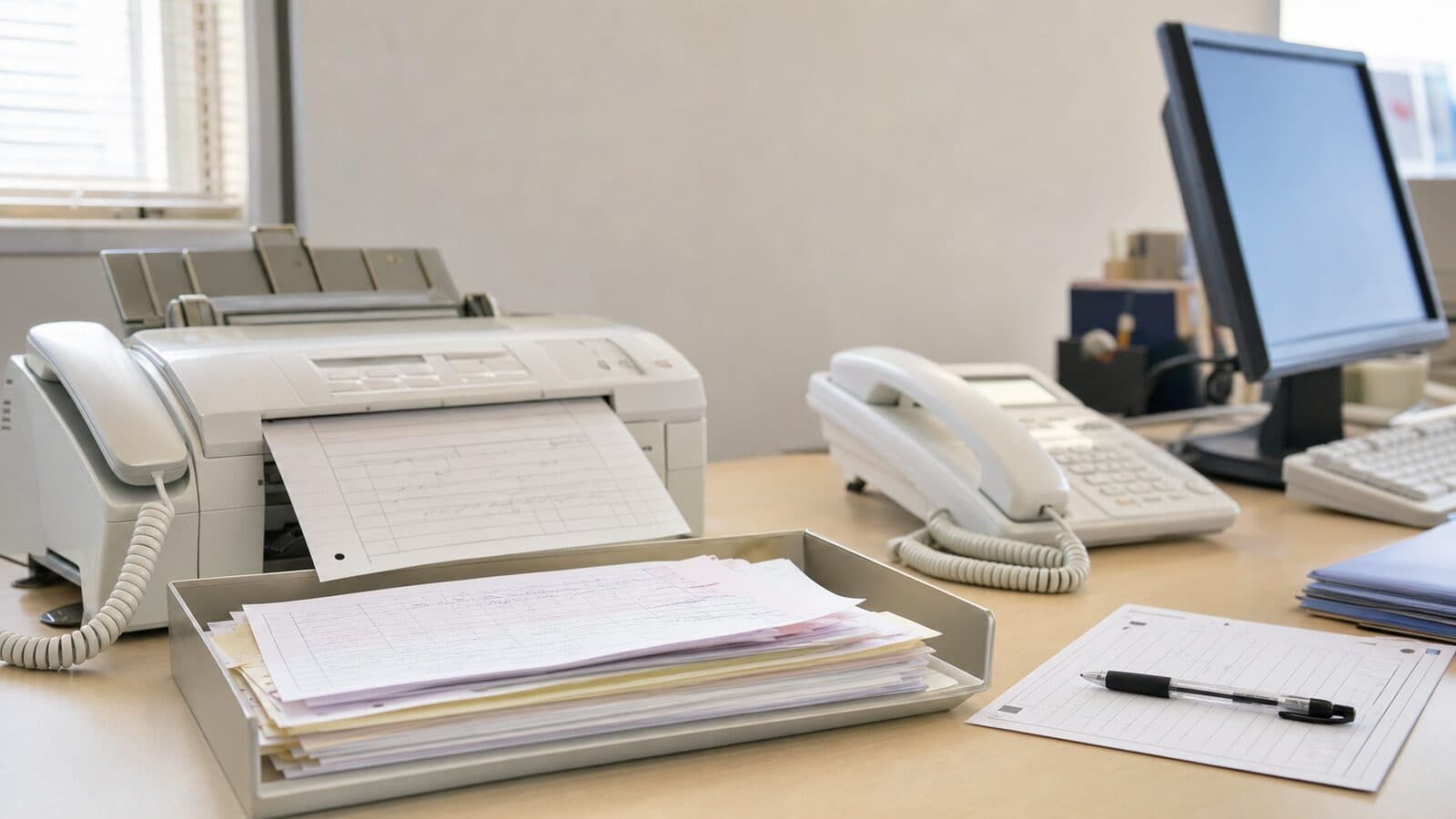
5–10 hours per day spent on order entry
AI reads and enters; humans just approve
Paper faxes pile up on shelves, impossible to search
Orders become structured data — an operational asset
Orders stop when a veteran retires
Tacit rules live in the AI, preserved as organizational knowledge
Stockouts and mis-shipments from entry errors
Confidence thresholds surface only uncertain items for human review
Considerations When Adopting the AI Digital Worker
01Design the boundary between AI judgment and human judgment up front
Set confidence thresholds, per-client rules, and exception flows before go-live. Agreeing on this design lets you balance automation rate against error risk in line with on-the-ground operations.
02Cataloging tacit rules determines adoption quality
Write down rules like 'this client only provides product names, so interpret them as X' or 'this abbreviation means this SKU' — these become training material for the AI. The shorter this phase, the faster the ramp-up.
03No core system changes required — but output formats must be agreed
The AI Digital Worker exports via CSV/EDI, so configuration changes on the core system side are generally unnecessary. However, field-to-column mappings should be agreed during onboarding.
AI Digital Worker by Industry
Order forms, industry jargon, and SKU systems differ sharply by industry. AI Digital Worker offerings are optimized per industry, with models tailored to each field.
AI Digital Worker for Food Wholesale
Produce, seafood, meat, liquor, foodservice supplies, and more. The AI memorizes industry terminology and each client's 'usual' orders to automate order intake.
AI Digital Worker for Electrical, Plumbing & Construction Material Wholesale
Handles over 100,000 SKUs. Translates manufacturer SKUs to internal SKUs, searches compatible parts, and captures veterans' SKU expertise as AI memory.
Frequently Asked Questions
How is this different from OCR?
OCR is a tool that only reads characters — interpretation and data entry remain human work. The AI Digital Worker handles the full pipeline: reading, applying client-specific rules, SKU conversion, confidence-based verification, and core-system entry. OCR is a component; the AI Digital Worker is a service that takes over the entire order-entry operation.
How is pricing structured?
A monthly subscription based on volume, number of clients, and the core systems you connect to. We provide individual quotes for initial and monthly fees — please contact us.
How long does implementation take?
Initial operation is possible in as little as 2–3 weeks. Given existing order samples and client rules, we move quickly from training-data preparation to pilot operation.
Is it secure?
Data is encrypted and stored in Japan regions. Your order data is never used to train third-party models. Access controls, audit logs, and BCP meet enterprise requirements.
How does it integrate with core systems?
Supports CSV and EDI export; no configuration changes are generally required on the core system side. Flexibly handles per-client format requirements. Proven integrations with major wholesale-industry core systems.
Ask an AI whether this fits you
Opens the AI you already use, preloaded with this service's facts and limitations. Get a second opinion on whether it fits. You can read and edit the text before sending it.